AI Essay Detector: The 2026 Guide for Teachers and Students
Teachers do not usually need another lecture about AI in education. They need a way to check suspicious essays without turning every review into a browser workflow, a privacy exception, or a guess. Students who care about originality need the same thing from the other side.
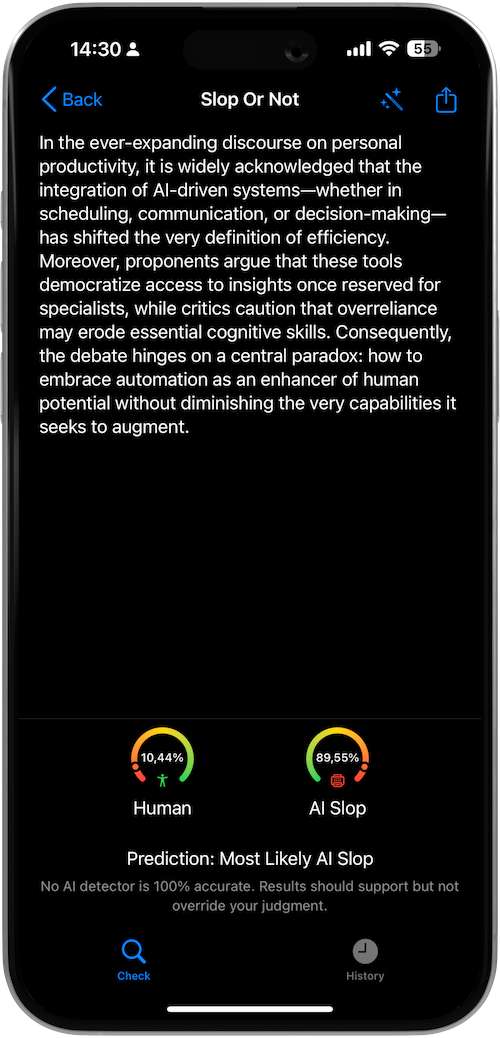
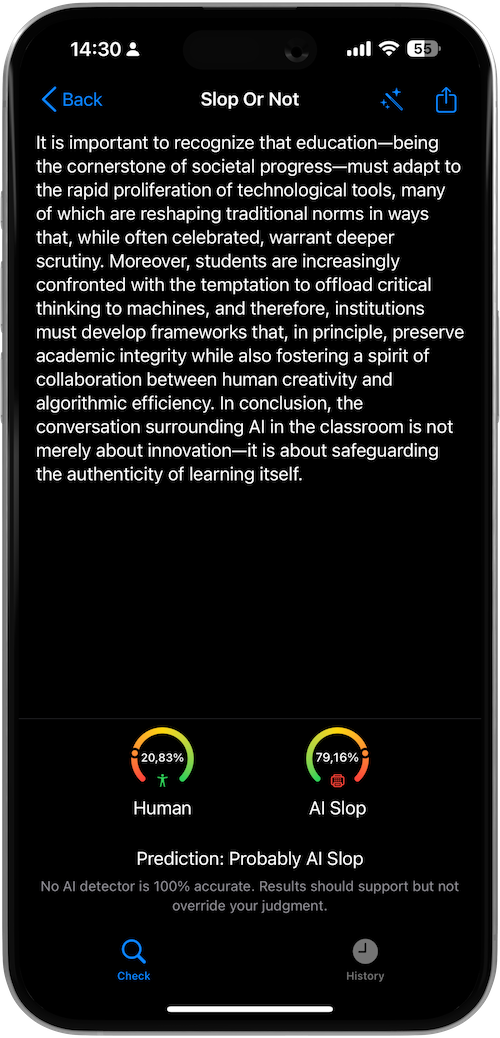
An AI essay detector is useful only if it fits the real job: check the whole draft, keep the text private when needed, and get a result quickly enough to act on it. Slop Or Not is built for that Apple-device workflow. It runs on-device, it has no word limits per document or per month, and it lets you scan long essays without uploading them to a cloud detector.
If you only need to check a suspicious essay, run it through the free online AI text detector, or use the iPhone or Mac app so the draft stays on-device.
Tested on iPhone 16 Pro, iOS 26, April 2026, and on Mac with Apple silicon, using long-form student-style essays, scholarship statements, and short reflection assignments.
Key Takeaways
- Teachers usually care more about privacy and long-document checks than brand names.
- Slop Or Not scans full essays on-device with no word limit per document or per month.
- Proofademic is closer to an academic SaaS workflow for classrooms and institutions.
- Students can use the same detector to sanity-check their own final draft before submission.
What Should an AI Essay Detector Actually Help You Do?
An AI essay detector should help you check a full essay quickly, keep sensitive text in the right place, and make a practical decision about what to review next. It is not a court-proof authorship machine, and pages that pretend otherwise are not being serious with you.
That means the useful questions are concrete:
- Can I paste the whole essay at once?
- Do I need to upload student work?
- Can I use it from the device already in my hand?
- Does it fit a classroom workflow or an individual spot check?
Those questions matter more than vague "best detector" claims.
How Many Students Are Actually Using AI for Schoolwork?
The share of US teens using ChatGPT for schoolwork doubled from 13 percent in 2023 to 26 percent in 2024, according to a Pew Research Center survey of 1,391 teens ages 13 to 17 published in January 2025.
The number keeps climbing. A follow-up Pew survey published in December 2025 found roughly two-thirds of teens now use AI chatbots, with 59 percent using ChatGPT specifically. That is more than twice the rate of any other chatbot Pew measured.
Teachers feel the shift. In a 2024 Pew survey of 2,531 US public K-12 teachers, 25 percent said AI tools do more harm than good in K-12 education, rising to 35 percent among high school teachers. Only 6 percent said they see more good than harm.
Can Teachers Actually Spot AI-Generated Essays Without a Tool?
Not reliably. A ScienceDirect study across 89 novice and 200 experienced teachers found that both groups failed to distinguish ChatGPT-generated essays from student-written texts. Participants correctly identified only 60 percent of human-written texts and 58 percent of AI-generated texts, barely above chance. Both groups were also overconfident in their judgments.
That matches the TRAILS analysis from the University of Maryland, which notes that detector reliability drops sharply on mixed AI and human content, and that false positives on genuine student writing are a real risk. Treat any detector output as a prompt for a conversation, not a verdict.
Why Does On-Device Checking Matter for Essays?
On-device checking matters because essays often contain student work, personal statements, scholarship applications, or internal drafts that do not belong in a generic browser upload. Slop Or Not runs the detection model locally on your device, so the text stays there.
That changes the workflow in a way teachers notice fast. Instead of breaking a long essay into chunks and pasting it into a web form, you can paste the whole text, run the scan, and move on to the next decision.
It also helps students. Plenty of students are not trying to cheat. They are trying to make sure an over-edited draft or an AI-assisted brainstorm still sounds like their own work.
Reading-Level Checks for Assigned Writing
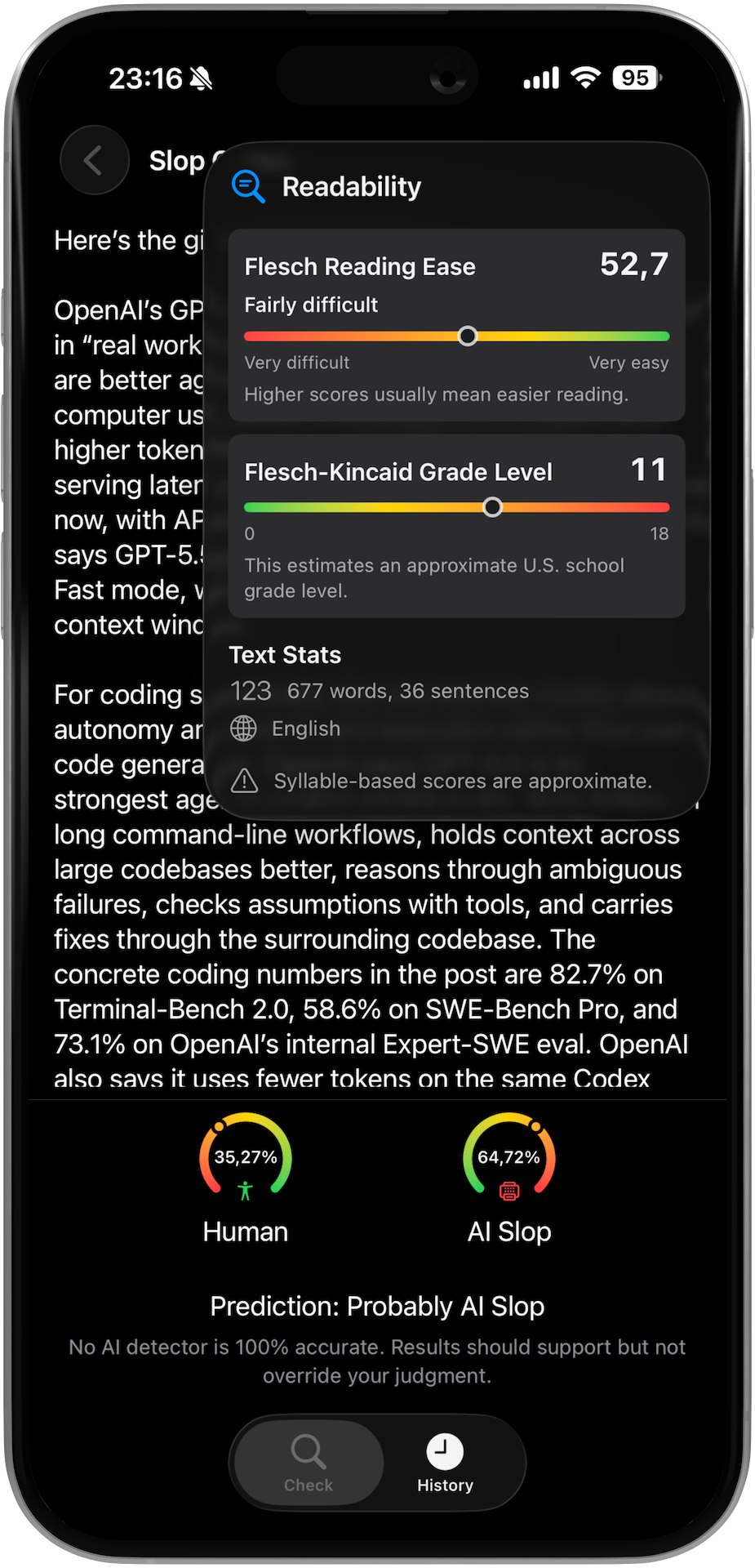
Every essay check in Slop Or Not also returns an on-device readability score in 7 languages, using the formula that fits each language: English (Flesch Reading Ease, higher is easier to read, plus Flesch-Kincaid Grade Level, an approximate U.S. school grade), German (Wiener Sachtextformel), Spanish (Flesch-Szigriszt), Italian (GULPEASE), Swedish, Danish, and Norwegian (LIX). The score sits alongside the AI detection result on the same screen.
For teachers, that is useful before you reach a verdict. A senior-level essay written at a fifth-grade level, or a primary-school assignment written at college level, is a signal worth reading the draft for. The score estimates how hard the text is to read, not whether AI wrote it; use it as a second lens on the same passage, not a replacement for the AI verdict.
Two caveats from the in-app screen are worth carrying into your workflow. Every formula in the lineup is approximate, so a single result is a gauge, not a precise measurement. The formulas and their scales also differ between languages, so do not compare scores across drafts written in different languages.
What Makes Slop Or Not Different From Proofademic?
Slop Or Not is built for private on-device essay checks across Apple devices. Proofademic is closer to an academic AI-detection platform with a classroom and institution workflow. If you are comparing the two, the split is private Apple-device checks versus browser-based education tooling.
That is the cleanest way to frame it:
| Feature | Slop Or Not | Proofademic |
|---|---|---|
Primary workflow | Private Apple-device spot checks | Browser-based academic workflow |
Word limits | None, per document or per month | 1,000-word free-tier ceiling |
Where text is processed | On your device | Remote platform workflow |
Best fit | Teachers, students, journalists, private professionals | Institutions and academic admin workflows |
Image checks | Yes | Text-first workflow |
If Proofademic is the exact product you are evaluating, the dedicated Proofademic comparison breaks that trade-off down in more detail.
How Accurate Are AI Essay Detectors in 2026?
Slop Or Not reports 95 percent accuracy on AI-generated text based on internal testing, with a caveat the brand treats as load-bearing: accuracy varies with new AI models and methods designed to trick detectors. That caveat is not marketing hedging. It is the honest answer.
The AI content detection software market is estimated at USD 2.20 billion in 2026 and projected to reach USD 8.56 billion by 2033, according to Coherent Market Insights. The growth is real, but so is the moving target: detectors and generation models are in an ongoing arms race, and no detector should be treated as standalone proof of authorship.
The practical rule for teachers and students is the same rule Pew, Stanford, and TRAILS arrive at from different angles. Treat a detector as triage, not as a verdict. Use it to decide which essays need a closer human read.
How Accurate Is Turnitin's AI Detector?
Turnitin is the detector most teachers already have through their institution, which is why its numbers matter even if you end up using something else. Turnitin publishes 98 percent accuracy on its own documents with a less than 1 percent false positive rate at the document level. Independent studies rarely reproduce that ceiling. Stanford's HAI research on AI detection has flagged higher false positive rates on non-native English writers, and university reporting across 2024 and 2025 showed teacher confidence is still the practical limit on how the number gets used.
The takeaway is the same as with any detector in 2026. A high single-document score is a reason to take a closer human look, not a reason to issue a verdict. Slop Or Not is no different — the difference is where the text lives during that check. On-device checks keep the student's draft on your Apple device instead of inside an institution's vendor pipeline.
What Signs Still Matter Before You Run the Check?
You should still read the essay like a human before you run a detector. The fastest useful signals are usually:
- smooth but generic paragraphs with few specific details
- repeated transitions or overly tidy structure
- citations or facts that look plausible but do not resolve cleanly
- a tone shift between the student's usual work and the new submission
Those signs are not proof. They are triage. The detector helps you decide whether the text deserves a closer look, not whether a student is automatically guilty of anything.
Who Should Use Slop Or Not Instead of a Browser Essay Detector?
Slop Or Not is strongest for teachers and students who want a fast private check across Apple devices, especially when long essays or sensitive text make browser uploads annoying or inappropriate.
It also fits:
- tutoring sessions where you want a quick check on a draft
- scholarship or admissions essays reviewed from an Apple device
- journalist or editor reviews of submitted opinion pieces
- HR or legal checks on sensitive written material
If you need institution-wide dashboards, student rosters, or classroom-scale admin features, a browser platform may fit better. If you need a detector in your pocket, Slop Or Not fits better.
FAQ
Does Slop Or Not have a word limit for essays?
No word limit per document or per month. The free plan limits how many checks you run each day, not how long the essay can be.
Is it private enough for student work?
Yes. The detection runs on-device, so the source text does not leave your device.
Is Proofademic better for schools?
It can be, if the school wants a browser-based academic workflow with institution-style management. Slop Or Not is better when the job is private mobile spot checks.
Can students use this too?
Yes. Students can use it to check their own final draft before they submit, especially if they used AI for brainstorming but wrote the essay themselves.
Verdict
The best AI essay detector is the one that fits the real review workflow. For private, fast essay checks across Apple devices, Slop Or Not is the stronger tool. For institution-style academic workflows, Proofademic may fit better. That is why the right answer depends on the job, not the logo.
For private essay checks with no word cap per document or per month, download Slop or Not. If you want the side-by-side comparison first, open Proofademic vs Slop or Not.