

slop_statusCheck app and Pro status
Confirms the app is installed, the binary can run, and Pro is active before the agent starts a workflow.
View payload and result
Tool input
{}Result shape
{
"pro": true,
"version": "1.1.1"
}On-device AI detector scoring
The Slop or Not MCP server lets Claude, Codex, Hermes Agent, OpenClaw, Cursor, and other agents call a local AI text detector, AI image detector, readability analyzer, and cleanup tool on your Mac.
Point your MCP client at the bundled slop mcp command. With Pro, Claude, Codex, Hermes Agent, OpenClaw, Cursor, and other agents can keep running local checks without per-call API metering.


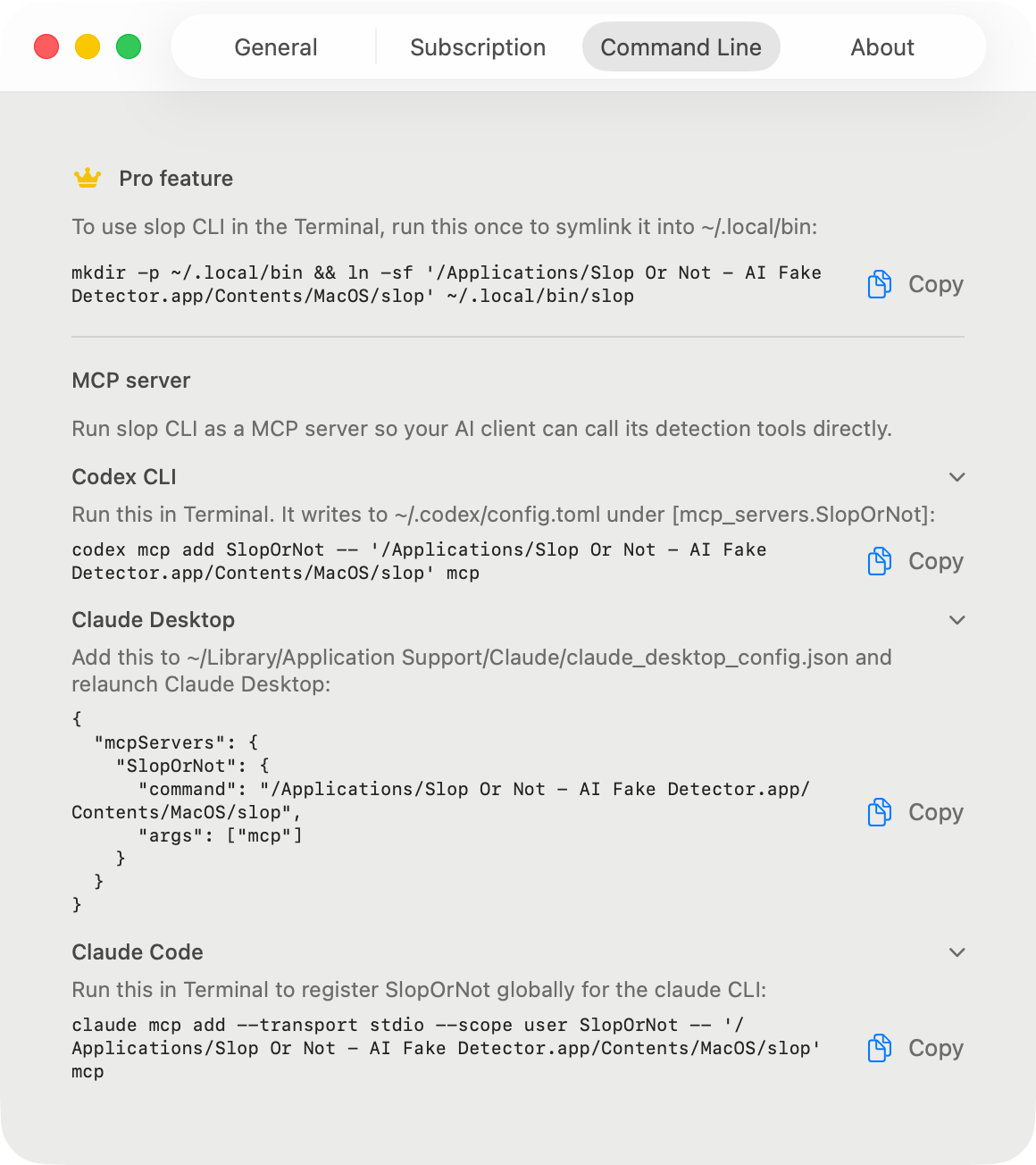
Client setup
Install the Mac app, activate Pro, then use the app-bundle snippet for your client. Claude, Codex, Hermes Agent, OpenClaw, and Cursor all point at the same local server. Set it up once and every agent session after that reuses it, with no reinstall and no new login.
claude mcp add --transport stdio --scope user SlopOrNot -- "/Applications/Slop Or Not.app/Contents/MacOS/slop" mcp{
"mcpServers": {
"SlopOrNot": {
"command": "/Applications/Slop Or Not.app/Contents/MacOS/slop",
"args": ["mcp"]
}
}
}codex mcp add SlopOrNot -- '/Applications/Slop Or Not.app/Contents/MacOS/slop' mcpPrefer to edit the file? Add this to ~/.codex/config.toml instead:
[mcp_servers.SlopOrNot]
command = "/Applications/Slop Or Not.app/Contents/MacOS/slop"
args = ["mcp"]mcp_servers:
SlopOrNot:
command: "/Applications/Slop Or Not.app/Contents/MacOS/slop"
args: ["mcp"]openclaw mcp set slopornot '{"command":"/Applications/Slop Or Not.app/Contents/MacOS/slop","args":["mcp"]}'
openclaw mcp doctor slopornot --probe{
"mcpServers": {
"SlopOrNot": {
"command": "/Applications/Slop Or Not.app/Contents/MacOS/slop",
"args": ["mcp"]
}
}
}Tool reference
The server provides six tools for the checks agents usually need: status, text detection, readability, cleanup, image detection, and raw image scoring.
Every result below is real output, captured from Slop or Not 1.1.1 for Mac in August 2026 and abridged where marked.
slop_statusConfirms the app is installed, the binary can run, and Pro is active before the agent starts a workflow.
Tool input
{}Result shape
{
  "pro": true,
  "version": "1.1.1"
}detect_textScores a passage with the on-device AI text detection model and returns a verdict, score, language, sentence count, and readability metrics.
Tool input
{
  "text": "<text>",
  "include_readability": true,
  "language_code": "en",
  "locale": "en-US"
}
Result shape
{
  "kind": "result",
  "verdict": "most_likely_real",
  "score": 0.1259,
  "language": "en",
  "sentence_count": 2,
  "generator": null,
  "input_truncated": false,
  "readability": {
    "language": "en",
    "language_confidence": 0.9998,
    "scores": [
      { "kind": "fleschReadingEase", "value": 50.85, "label": "Fairly difficult", … },
      { "kind": "fleschKincaidGradeLevel", "value": 16.97, … }
    ],
    "word_count": 87,
    "sentence_count": 2,
    "avg_words_per_sentence": 43.5,
    "warnings": [ … ],
    "full": { "consensus": { … }, "genre": { … }, "grade_label": { … }, … }
  }
}analyze_readabilityComputes reading-level metrics without running AI detection.
Tool input
{
  "text": "<text>",
  "language_code": "en",
  "locale": "en-US"
}
Result shape
{
  "language": "en",
  "language_confidence": 0.9998,
  "scores": [
    { "kind": "fleschReadingEase", "value": 50.85, "label": "Fairly difficult", … },
    { "kind": "fleschKincaidGradeLevel", "value": 16.97, … }
  ],
  "avg_words_per_sentence": 43.5,
  "sentence_count": 2,
  "word_count": 87,
  "warnings": [ … ],
  "full": { "consensus": { … }, "genre": { … }, "grade_label": { … }, … }
}clean_textStrips zero-width characters, homoglyphs, and fancy punctuation before the next detection pass.
Tool input
{
  "text": "<text>",
  "language_code": "en",
  "remove_invisibles": true,
  "remove_punctuation": true,
  "remove_homoglyphs": true,
  "britishize": false
}
Result shape
{
  "cleaned_text": "He said \"hello\" - and left.",
  "language": "en",
  "removed_invisibles": 1,
  "punctuation_replacements": 3,
  "homoglyphs_replaced": 0,
  "british_substitutions": 0
}detect_imageChecks JPEG, PNG, HEIC, or WebP image bytes locally with C2PA and IPTC provenance reads and an on-device model fallback. The result names its detection_source, so an agent can tell a provenance hit from a model score.
Tool input
{
  "image_base64": "<base64>",
  "recognize_text": false
}
Result shape
{
  "kind": "result",
  "verdict": "probably_ai_slop",
  "score": 0.6429,
  "generator": null,
  "detection_source": "ml",
  "watermark_provider": null,
  "watermark_confidence": null,
  "recognized_text": null,
  "recognized_sentence_count": null
}score_imageReturns the raw image-model score without the full provenance-aware image-detection response. Requires the AI image detection model to be installed.
Tool input
{
  "image_base64": "<base64>"
}
Result shape
{
  "raw_slop_score": 0.33984375
}
Verify
After restart, ask your agent to run slop_status. The expected result is a tool call that reports the local app and Pro state without an error. A call that needs Pro comes back as a tool error (isError: true) while the server keeps running, so one blocked call never ends the session.
{
  "pro": true,
  "version": "1.1.1"
}Troubleshooting
GUI agents can launch outside your login shell, where command names may not resolve. The snippets use the signed app-bundle path so each client starts the same bundled Slop or Not binary.
Local API
For agent workflows, yes. MCP gives Claude, Codex, Hermes Agent, OpenClaw, Cursor, and other clients a local tool interface instead of a hosted AI detector API. The client sends text or image data to the bundled Mac binary over stdio, and the check runs on your Mac.
Loop with agents
The agentic AI Humanizer skill can run core rewriting and voice matching without Slop or Not. Connect it to Slop or Not with Pro active when you want MCP tools to score a baseline, run Text Cleanup before and after humanization, re-score with the on-device AI detector, and show cleanup stats. Your writing sample steers the rewrite; Slop or Not supplies local AI detector measurement.
Slop or Not returns a probability verdict, not proof of authorship. Results can vary with new AI models, short passages, and writing that was heavily edited by a human.
Help us understand how this site is used. Privacy policy